
What people ask about history
Select a question to open the answer. Each one links to the organization that keeps the details current.
HistoryHow did Carmel begin, and why isn't it called Bethlehem?
On April 13, 1837, John Felps (Phelps), Alexander Mills, Seth Green and Daniel Warren laid out the Town of Bethlehem, a plat of fourteen lots in an area that soon filled with Quakers. When a post office opened in 1846, residents learned the United States Post Office already had another Bethlehem in Indiana, so in 1874, by a referendum vote of 33 to 12, the town incorporated and took the name Carmel.
The city's current logo still nods to the old name with a subtle eight-point star for Bethlehem.
Reviewed November 2026
HistoryHow did the Monon Railroad become the Monon Greenway?
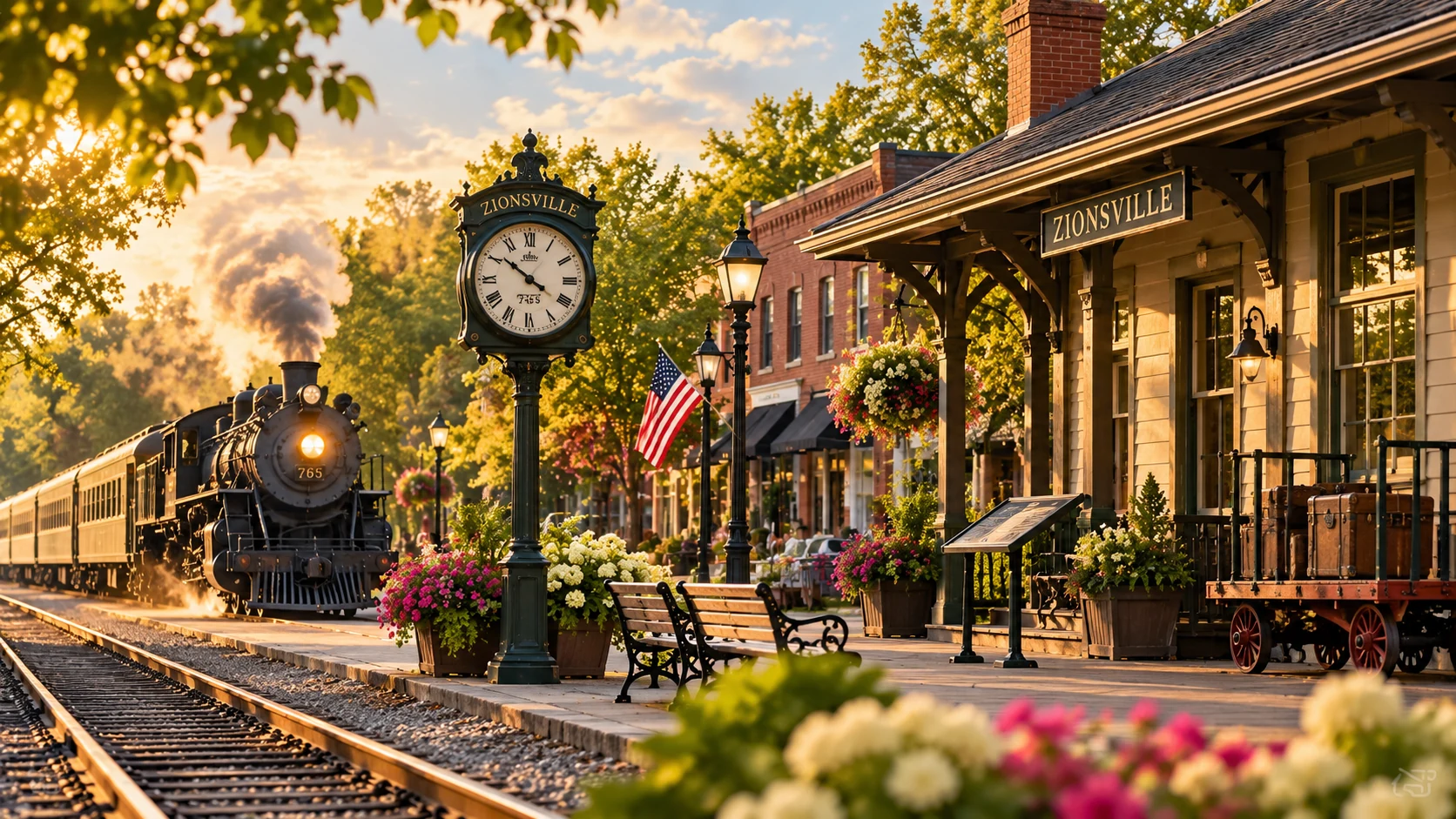
Monon Railroad tracks were laid through Carmel in 1882, and a depot opened in 1883 that stayed open until 1974. In 1975 the city gave the 1883 depot to the Carmel Clay Historical Society, formed that same year, which keeps it as the Monon Depot Museum of local history. The 5.2-mile Monon Trail opened from 96th Street to 146th Street in 2002.
Today the city maintains the 5.2-mile Carmel portion of the Monon Greenway, a rails-to-trails project that runs from 96th Street to Westfield.
Reviewed November 2026
HistoryDid Carmel really have one of the first traffic signals?
Yes. In 1924 Leslie Haines invented one of the country's first automatic stop-and-go traffic signals, and it stood at the intersection of Main Street and Range Line Road.
Reviewed November 2026
HistoryWhy does Carmel have so many roundabouts?
Carmel is noted for having well over 100 roundabouts. The city finished its 100th roundabout, at Carmel Drive and Range Line Road, in 2016, and its roundabout program has won national recognition, including a 2006 City Livability Award and a 2008 first place in the Climate Protection Awards, both from the U.S. Conference of Mayors.
In 2011 Carmel hosted the Transportation Research Board's National Roundabout Conference. The fire department's S.A.F.E. House includes navigating roundabouts among its safety simulations.
Tip: slow down as you approach, yield to traffic already in the circle, and use your turn signal as you exit.
Reviewed November 2026
HistoryHow did Carmel grow from a small town into a city?
Carmel's growth came in steps. In 1965 Carmel annexed Woodland Springs, Cool Creek and Keystone Square, doubling its population. Residents voted in 1974 to become a city, and the first city officials, including Mayor Albert Pickett, took office on January 1, 1976.
A 2007 special census counted 68,677 people, and the 2020 census counted 99,757. In 2016 the City Council voted to make Carmel a second-class city. Along the way the city built City Center, which grew out of an abandoned strip mall, and opened Midtown Plaza in 2019.
Reviewed November 2026
HistoryWhen were Carmel's parks and the Monon Community Center built?
Carmel Clay Parks & Recreation was founded in 1991 through an agreement between the City of Carmel and Clay Township. The Monon Center and The Waterpark opened on Memorial Day 2007, and in 2012 the FlowRider® opened at The Waterpark as the first of its kind in Indiana.
The department won the National Gold Medal Award in 2014 and again in 2020.
Reviewed November 2026
HistoryHow did Carmel Dads' Club and Badger Park start?
In 1958 a handful of dads gathered boys to play baseball against kids from Westfield, and the group became Carmel Dads' Club in 1959. In 1978 the club bought the 39-acre "Blue Farm" off 131st Street, and in 1980 the board named the new complex Mark Badger Memorial Park for a young player who died of a brain stem tumor in 1979.
The first Carmel Dads' Club soccer field opened there in 1983, the first baseball game at O'Malia Diamond was played in 1987, and the Aletto Family Sports Center opened in February 2022.
Reviewed November 2026
HistoryWhere can I learn more about Carmel's history?
Start with the Carmel Clay Historical Society, formed in 1975, which collects and preserves the history of Carmel and Clay Township and runs the Monon Depot Museum in the restored 1883 railroad depot. The city's History page also keeps a year-by-year timeline from 1837 on.
Reviewed November 2026
Spot something wrong or out of date? Let us know and we will check it against the source.